Join PW Trenchless Construction Inc. on the 14th of January at the Hilton Vancouver Metrotown for our latest in-depth educational event. This event will strengthen your practical skills in condition assessment and trenchless method selection, broaden your knowledge of pipe bursting methods and applications, and cover a wide range of resins, gels, and foams used to address I&I, condition soils, and support a wide range of trenchless applications. Stick around for a Q&A, networking session, and a delicious buffet lunch.
Wastewater Utilities: Our Public Immune System
|
Innovations in waste management were often driven by health crises.
|
|
|
Today, infrastructure can help us prevent and track the spread of disease.
|
|
Before Germ Theory, We Had Infrastructure
|
| Before advances in microscopy, chemistry, and biology in the 18th and 19th centuries, germ theory could not be verified. Left with only observation and experience, societies developed practical ways to reduce illness—particularly around water and waste.
As early as 3000 BC, Mesopotamian texts distinguished between “sweet” and “foul” waters, reflecting an understanding of the connection between water quality and disease. Weak beer, often safer than available water, served as a primary source of hydration in early cities. Centuries later, the Hippocratic Corpus warned of illness associated with mixing water sources. While framed through ancient philosophy rather than microbiology, the conclusion was clear: water management mattered.
From Roman aqueducts and baths to large-scale brewing along the Nile, ancient societies used infrastructure to protect public health long before they understood pathogens. |
 |
| This cuneiform tablet is similar to those found containing a hymn to Ninkasi, the Mesopotamian goddess of beer. While the hymn itself is not a recipe, it does allude to the brewing process and cultural importance of beer in ancient Mesopotamian society. |
Infrastructure as a Public Immune System
|
| Modern water and wastewater systems serve the same purpose today. Storm and sewer networks remove waste and stagnant water, while treatment plants provide safe drinking water to billions—an achievement unimaginable less than 150 years ago. Increasingly, wastewater monitoring allows health authorities to track disease spread and respond with targeted interventions rather than broad, disruptive measures.
None of this is possible without the sanitation principles developed nearly two centuries ago. |
Cholera and a Turning Point
|
| In the 19th century, cholera forced Europe to confront the limits of its medical understanding. Mortality rates among infected patients often reached 30–60 percent, rivaling those of the Black Death. Without antibiotics or modern sanitation, ineffective and sometimes dangerous treatments were common.
In 1854, London physician John Snow challenged prevailing miasma theory by mapping cholera cases around the Broad Street water pump. When the pump handle was removed, the outbreak rapidly declined. Snow demonstrated that disease was not abstract or atmospheric—it was material, traceable, and transmitted through infrastructure. |
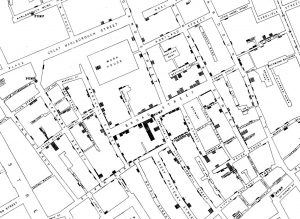 This map of the Broad Street ward of London shows John Snow’s methodology for tracking the source of the cholera outbreak. The dark marks made along each street represent the location and number of cholera patients observed by Dr. Snow. At the centre of the map, very near to the worst affected residences, is the Broad Street water pump. This map of the Broad Street ward of London shows John Snow’s methodology for tracking the source of the cholera outbreak. The dark marks made along each street represent the location and number of cholera patients observed by Dr. Snow. At the centre of the map, very near to the worst affected residences, is the Broad Street water pump. |
Disease Prevention Through Engineering
|
|
|
| Snow’s work helped drive major investments in sewer and water systems. Alongside the development of antibiotics in the early 20th century, these advances transformed drinking water from a major disease vector into a controlled utility. Infectious disease, once humanity’s leading cause of death, was surpassed by heart disease in Western countries by around 1920.
Yet infectious disease remains a global threat. Influenza, malaria, cholera, and COVID-19 continue to claim millions of lives, while antibiotic resistance and declining vaccination rates pose growing risks. Treating illness after it appears is the last line of defense. Preventing its spread is the first—and that responsibility rests largely with water and wastewater infrastructure. |
Resilient Infrastructure for Resilient Societies
|
| For most of human history, societies relied on observation and intuition to manage disease. Only in the past two centuries have we built the water, wastewater, and public-health systems that now function as a collective immune system.
That progress is not guaranteed. Aging infrastructure and emerging pathogens continue to expose vulnerabilities. The lesson remains clear: disease prevention begins long before a patient enters a clinic. It starts underground—with clean water, reliable sewer networks, effective monitoring, and timely maintenance. Trenchless technologies strengthen this first line of defense, helping protect public health by keeping essential infrastructure working as intended. |
|
|